
Activity category: Marine protected areas
Year: 2022
Type: Advocacy, Awareness raising, Scientific research
Status: Ongoing
Target areas: Inner Ionian Sea
Target organisms: Posidonia
Project website:
Partners

Funders
Activity category: Marine protected areas
Year: 2022
Type: Advocacy, Awareness raising, Scientific research
Status: Ongoing
Target areas: Inner Ionian Sea
Target organisms: Posidonia
Project website:
Partners
Funders
Objectives
iSea is working systematically in the area since 2022 with the aim of protecting Formicula islet and contributing to the effective science-based management of the area by empowering the Natural Environment & Climate Change Agency (NECCA). Since 2023, the work has been expanded in the near uninhabited islands, Atokos and Arkoudi. However, Formicula is at the center of our attention and is a top priority for its immediate protection which will benefit Posidonia meadows and the Mediterranean monk seal population. Below you can find the core actions that iSea is implementing in Formicula islet. Our main goals and actions include: Habitat mapping with remote sensing, biodiversity monitoring, posidonia meadows health assesment, blue carbon assesment, managment actions, assesing threats and awareness raising.
Description
Formicula (or Fermeculo) is a small uninhabited islet in the Inner Ionian Archipelago, covering just 8.7 hectares, yet hosting remarkable biodiversity. Its surrounding marine habitats include rocky reefs, Posidonia seagrass meadows, underwater caves, and sandy bottoms, supporting a rich variety of marine life. The well-developed Posidonia meadows play a crucial role in maintaining water quality, producing oxygen, and storing carbon, while also providing important breeding grounds for many species. These habitats are home to threatened species such as groupers (Epinephelus marginatus and Epinephelus costae) and the Mediterranean monk seal, one of the most endangered mammals worldwide.
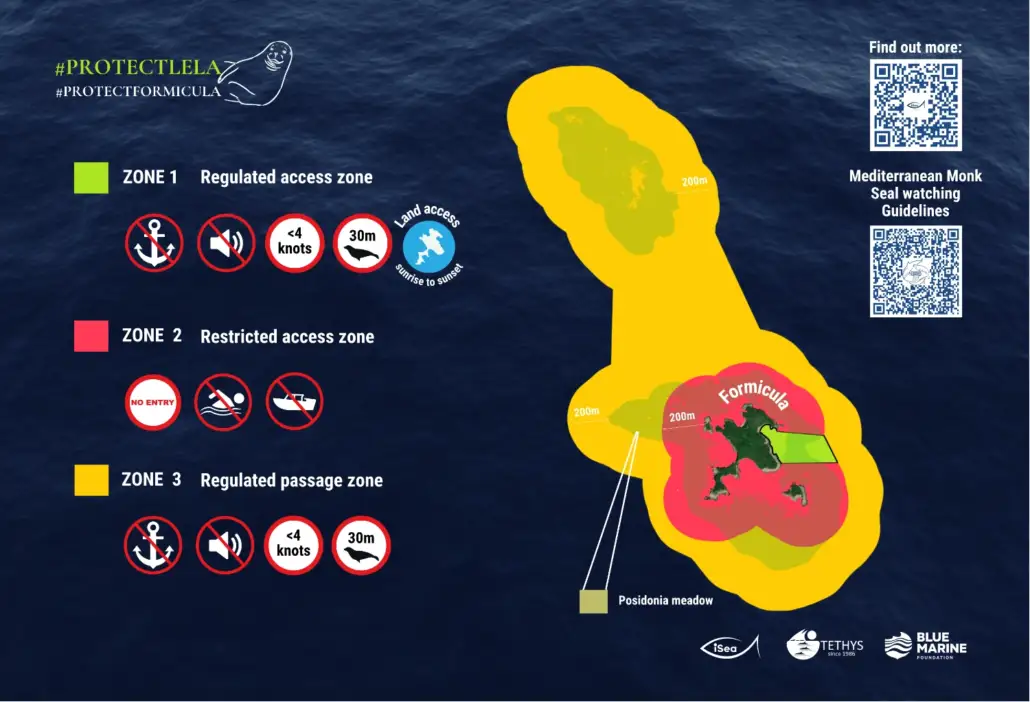
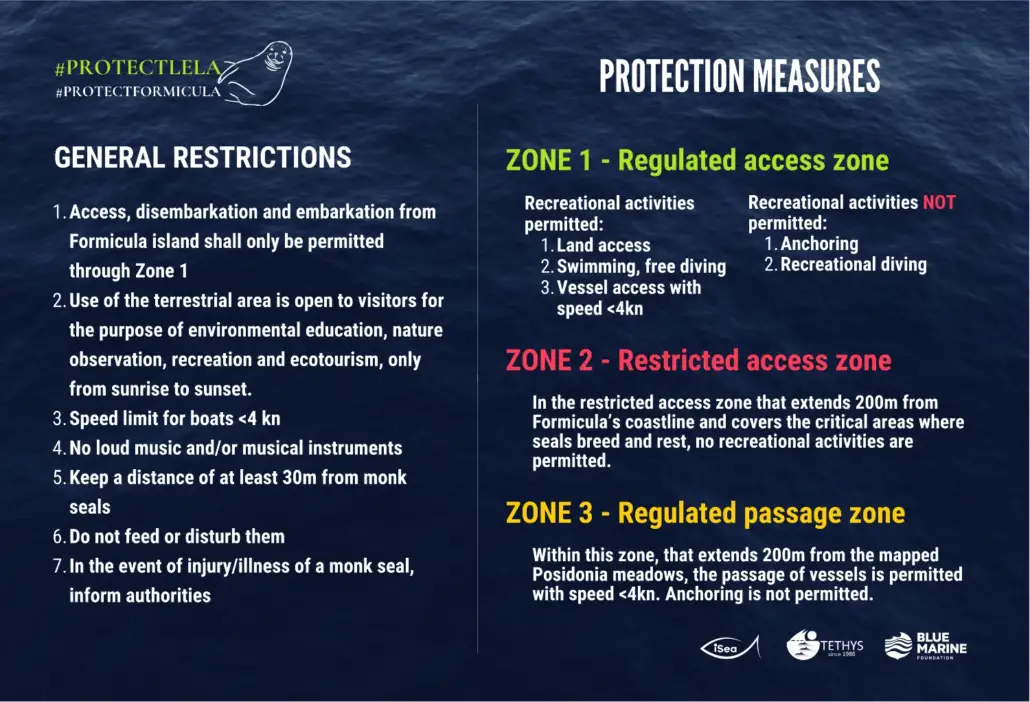
A major step for the protection of the area was the establishment of a 200-meter strict protection zone, following the Ministerial Decision 123711/3066 (Official Government Gazette 953/31.12.2024). The framework includes regulated and restricted access zones, aiming to minimize disturbance and safeguard critical habitats. Formicula is also part of the Natura 2000 Network (GR2220003) and has been identified as an Important Marine Mammal Area (IMMA), underlining its ecological importance.
Despite these measures, significant threats remain. Unregulated tourism and increased boat traffic disturb wildlife, particularly the Mediterranean monk seal, while uncontrolled anchoring damages sensitive Posidonia meadows. Illegal fishing practices, such as beach seining near critical habitats, continue to impact the ecosystem.
Results
Biodiversity monitoring has documented more than 80 marine species across 20 taxa, including fish, algae, sponges, molluscs, echinoderms, and marine mammals. The presence of invasive species, such as lionfish (Pterois miles) and rabbitfish (Siganus spp.), has also been observed, further emphasizing the need for continuous monitoring and management of the area.